
Mainfreight Limited (MFT.NZ) Navigates Margin Pressure: Technical Indicators Suggest Consolidation Ahead of FY26 Results
Mainfreight Limited (MFT.NZ) entered the final month of its 2026 financial reporting cycle with a renewed sense of momentum, closing the trading session on Saturday, May 2, 2026, at NZ$61.00. This represents a 3.39% daily increase, a performance that outpaced several of its peers on the NZX50. Despite this short-term strength, the logistics giant faces a complex macroeconomic backdrop characterized by fluctuating fuel costs and a global trade environment that remains sensitive to inflationary pressures. As the market anticipates the full-year 2026 (FY26) financial results scheduled for release on May 28, investors are weighing the company's long-term growth trajectory against the margin compression observed in recent interim reports.

Company Overview and Sector Positioning
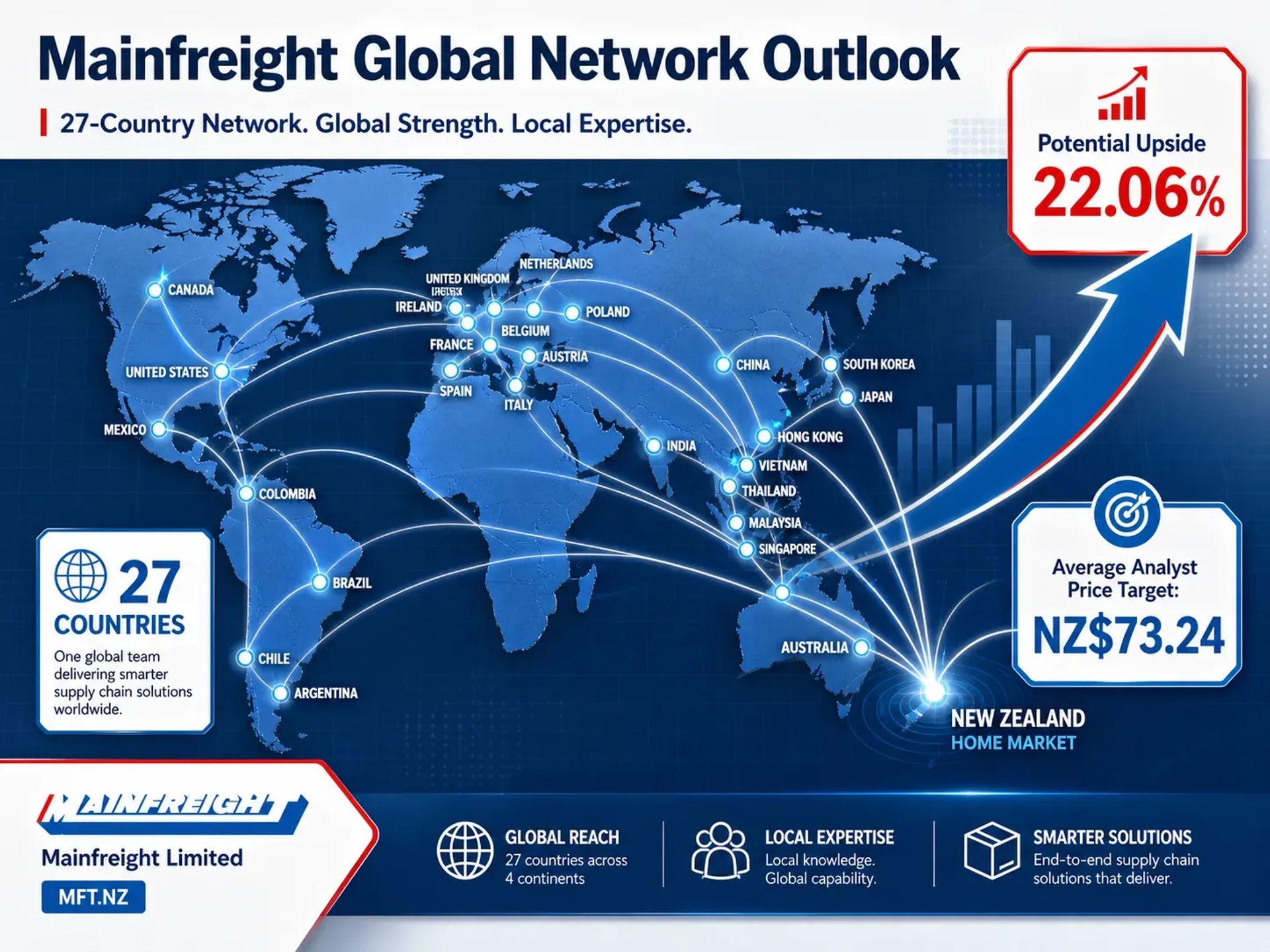
Mainfreight Limited is New Zealand's preeminent logistics and transport provider. Since its inception in 1978 and subsequent listing on the NZX in 1996, the company has transformed from a domestic freight forwarder into a global integrated supply chain powerhouse. Operating across 27 countries with more than 330 branches, Mainfreight’s footprint spans Europe, Australia, Asia, the Americas, and its home market of New Zealand.
The company’s competitive advantage lies in its decentralized management structure and its focus on high-quality, end-to-end logistics solutions, including warehousing, air and ocean freight, and domestic distribution. As of May 2, 2026, Mainfreight commands a market capitalization of approximately NZ$6.14 billion, placing it firmly within the top tier of the Industrials sector on the New Zealand exchange. Its ability to maintain a global network while navigating local disruptions—such as the New Zealand weather events reported on April 20, 2026—remains a core pillar of its operational resilience.
Financial Metrics and Valuation Discussion
Mainfreight’s financial narrative over the past 18 months has been a tale of two halves. For the full financial year ended March 31, 2025 (FY25), the company delivered robust growth, with total revenue rising 11% to NZ$5.25 billion and net profit surging 31% to NZ$274.3 million. However, the half-year results ended September 30, 2025 (HY26), signaled a shift in the operating environment. While revenue saw a modest increase of 2.1% to NZ$2.61 billion, net profit after tax (NPAT) fell 18.5% to NZ$93.38 million.

This discrepancy between top-line growth and bottom-line performance highlights the rising cost of doing business in the logistics sector. Operating expenses, particularly those linked to labor and facility expansion, have weighed on margins. Furthermore, the company reported that net funds (debt) increased to NZ$68.7 million for HY26, up from NZ$14 million at the end of FY25, reflecting ongoing capital expenditure in its global branch network.
From a valuation perspective, Mainfreight is currently trading at a P/E ratio of 24.263. This multiple suggests that the market continues to price in a premium for Mainfreight’s management quality and long-term earnings potential, even as short-term profits face headwinds. For income-focused investors, the gross dividend yield stands at 4.049%. The company maintained its commitment to shareholder returns by paying an interim dividend of 85 cents per share in December 2025.
Recent News and Market Catalysts
The immediate focus for MFT.NZ shareholders is the upcoming May 28 earnings release. This report will provide critical clarity on whether the margin compression seen in the first half of the year has stabilized. Recent operational updates have highlighted the volatility inherent in the New Zealand market. On April 20, 2026, the company issued advisories regarding weather-related disruptions that impacted domestic freight movements.
Perhaps more significant is the ongoing pressure from the energy market. As of April 7, 2026, Mainfreight has been closely monitoring fuel market conditions. This follows a March 2026 warning from logistics executives that prices for "anything attached to fuel" in New Zealand would likely trend upward. For a company with a massive land-based transport fleet, these costs are a direct threat to profitability unless they can be fully passed through via fuel surcharges. The market’s 3.39% lift on May 2 suggests a degree of optimism that these challenges are being managed, or perhaps that the stock had become oversold following its 4.00% decline in the previous week.
The Relative Strength Index (RSI 14) is currently at 56.42. This value is considered neutral, as it sits comfortably between the oversold threshold of 30 and the overbought threshold of 70. This suggests there is still significant "room to run" before the stock reaches an overextended state. Meanwhile, the Moving Average Convergence Divergence (MACD) is currently bullish, with the MACD line trending above the signal line. This technical crossover often precedes continued upward price action, aligning with the 3.39% gain seen on the most recent trading day.
Analyst Sentiment and Consensus
Professional sentiment toward Mainfreight remains overwhelmingly positive. According to data from 11 analysts covering the stock, the consensus rating is a 'Buy.' The breakdown of these recommendations includes 2 'Strong Buy' and 6 'Buy' ratings, with 3 analysts maintaining a 'Hold' position. Notably, there are zero 'Sell' or 'Strong Sell' recommendations currently issued for the company.
The average 12-month price target for MFT.NZ is NZ$73.24. Based on the May 2 closing price of NZ$61.00, this represents a potential upside of 22.06%. Even the most conservative analyst in the group has a price target of NZ$64.29, which is still above the current market price, while the most optimistic target reaches NZ$84.00. This tight clustering of targets above the current price indicates a high degree of confidence in the company’s fundamental value, despite the recent -1.63% change over the past 52 weeks.
Risk Factors and Outlook
While the consensus is bullish, several risks warrant caution. The primary concern remains the global economic slowdown, which could dampen international freight volumes. Mainfreight’s exposure to the Americas and Europe means it is susceptible to shifts in consumer spending and manufacturing output in those regions.
Domestically, the New Zealand operations are grappling with infrastructure challenges and the aforementioned fuel price volatility. The increase in net debt to NZ$68.7 million, while manageable given the company's size, does increase sensitivity to interest rate fluctuations. Investors will be scrutinizing the May 28 report for updates on the "Air & Ocean" segment, which has historically been a high-margin driver but has faced a normalization of freight rates globally following the post-pandemic boom.
Closing Summary and Investment Thesis
Mainfreight Limited (MFT.NZ) remains a cornerstone of the New Zealand industrial sector, offering investors exposure to a global logistics network with a proven track record of operational excellence. The current share price of NZ$61.00 reflects a market that is cautiously optimistic but wary of the margin pressures revealed in the HY26 results.
Technically, the stock is showing signs of life, with a bullish MACD and a price position above the 50-day SMA of 60.66. However, the real test will be the company’s ability to reclaim the 200-day SMA of 63.24. With an analyst price target of NZ$73.24 suggesting over 22% upside, the risk-reward profile appears attractive for long-term investors, provided the upcoming full-year results on May 28 demonstrate that management has successfully navigated the recent cost headwinds. For now, Mainfreight appears to be in a consolidation phase, building the necessary foundation for its next leg of growth.
Related Articles


Comments
0Loading...
No comments yet. Be the first to share your thoughts.
