Australian Housing Market Fractures as Sydney and Melbourne Prices Enter Quarterly Decline
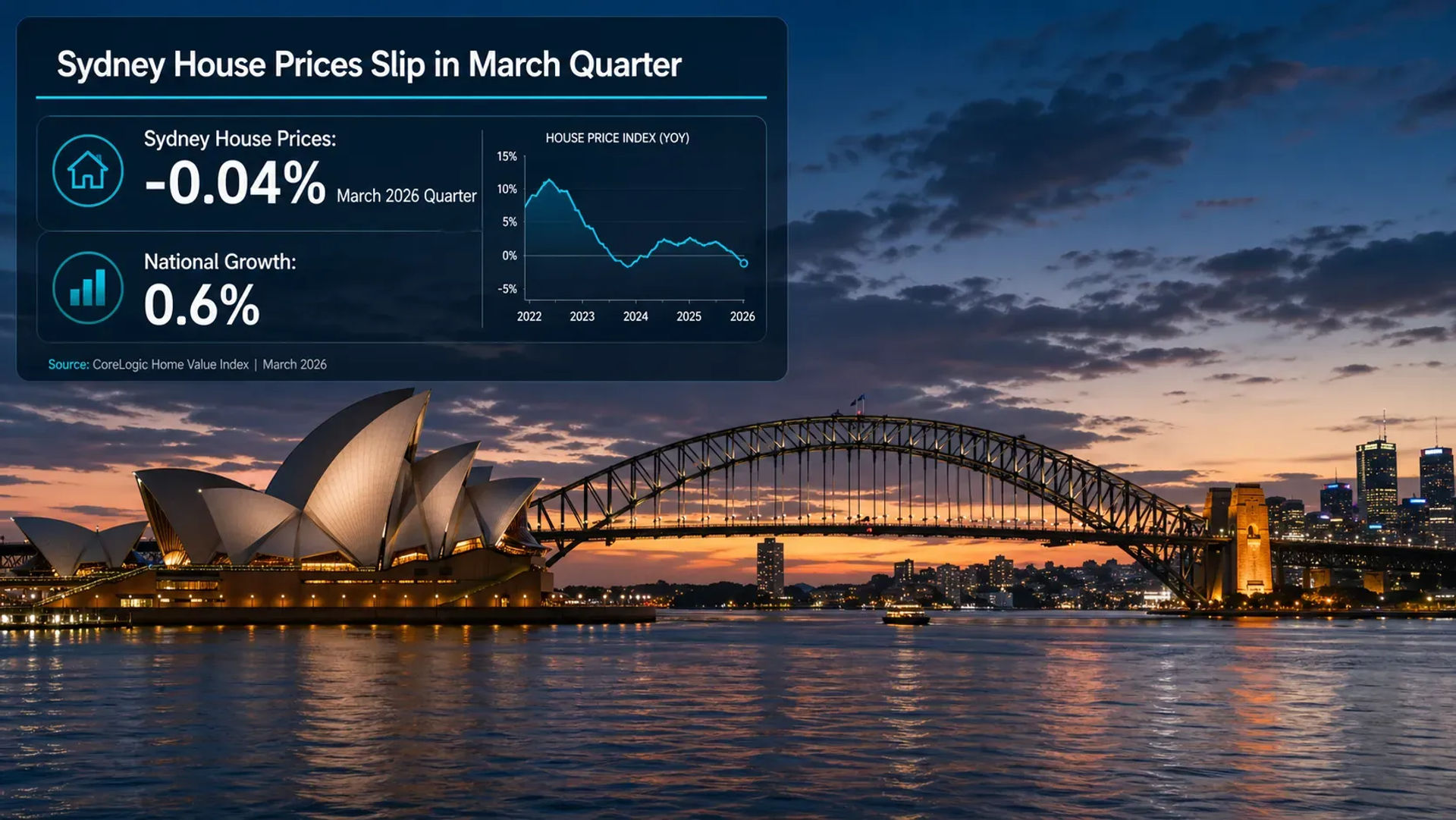
The Australian housing market has entered a period of significant divergence, according to the latest data for the March 2026 quarter. While national home values recorded their 14th consecutive month of growth with a 0.6% increase in March, the headline figure masks a deepening divide between the nation’s largest capital cities and the surging mid-sized markets of Western Australia, Queensland, and South Australia.
In a notable shift for the property sector, Sydney house prices declined by 0.04% over the March 2026 quarter—a modest drop of approximately $772, but one that marks the end of a three-year period of uninterrupted growth. Melbourne experienced a more pronounced correction, with house prices falling 0.6%, or roughly $6,357, marking the city’s first quarterly decline in 18 months. These figures suggest that the weight of sustained high interest rates and worsening affordability is finally curtailing demand in the nation's most expensive jurisdictions.

Perth Leads the 'Flight to Affordability'
While the southeastern capitals cooled, Perth continued to defy broader economic headwinds. House prices in the Western Australian capital surged by 5.7% in the March 2026 quarter alone, pushing the city's median house value to a record $1.179 million. On an annual basis, Perth has recorded a staggering 24.6% growth rate, the strongest in the country.
This trend is mirrored in Brisbane and Adelaide, which continue to lead annual price growth alongside Perth. As of the current reporting period, Perth, Adelaide, and Brisbane have maintained robust momentum, driven by a persistent imbalance between high demand—fuelled by interstate migration and population growth—and a chronic undersupply of new housing completions. Analysts describe this shift as a 'flight to affordability,' where buyers are increasingly looking toward mid-sized capitals as Sydney’s median values remain out of reach for many middle-income earners.
Units Show Resilience Amid House Price Softening
Interestingly, the unit market is showing greater resilience than detached housing in the larger capitals. In Sydney, unit prices rose by 0.6% over the March 2026 quarter to reach a new record high of $848,227. This marks 13 consecutive quarters of growth for the Sydney unit sector.
The divergence between houses and units in Sydney and Melbourne is largely attributed to the widening price gap between the two property types. As borrowing capacities are squeezed by high interest rates, many prospective buyers are being forced out of the detached housing market and into more affordable apartments, providing a floor for unit prices even as house values begin to soften.

Economic Headwinds and the RBA Outlook
The current slowdown in Sydney and Melbourne coincides with a sharp drop in consumer sentiment and the cumulative impact of restrictive monetary policy. The national median home value reached $933,137 in March 2026, but the pace of growth has slowed significantly from the rapid rebound seen throughout 2023 and 2024.
ANZ Research has updated its forecasts in light of these trends, expecting capital city dwelling values to increase by a modest 2.8% across the full 2026 calendar year, slowing further to 2.1% in 2027. A key factor in this outlook is the trajectory of the Reserve Bank of Australia (RBA) cash rate. ANZ Research anticipates the cash rate will peak at 4.35% in May 2026, keeping borrowing costs at their highest levels in over a decade for the foreseeable future.
Related Articles

Australian GDP growth slows to 0.3% as high rates and weather disrupt activity
Australia's economic growth slowed sharply to 0.3% in the first quarter of 2026, missing market expectations. Extreme weather disruptions and weak consumer spending dragged on activity, posing a policy dilemma for the Reserve Bank of Australia.

Comments
0Loading...
No comments yet. Be the first to share your thoughts.

