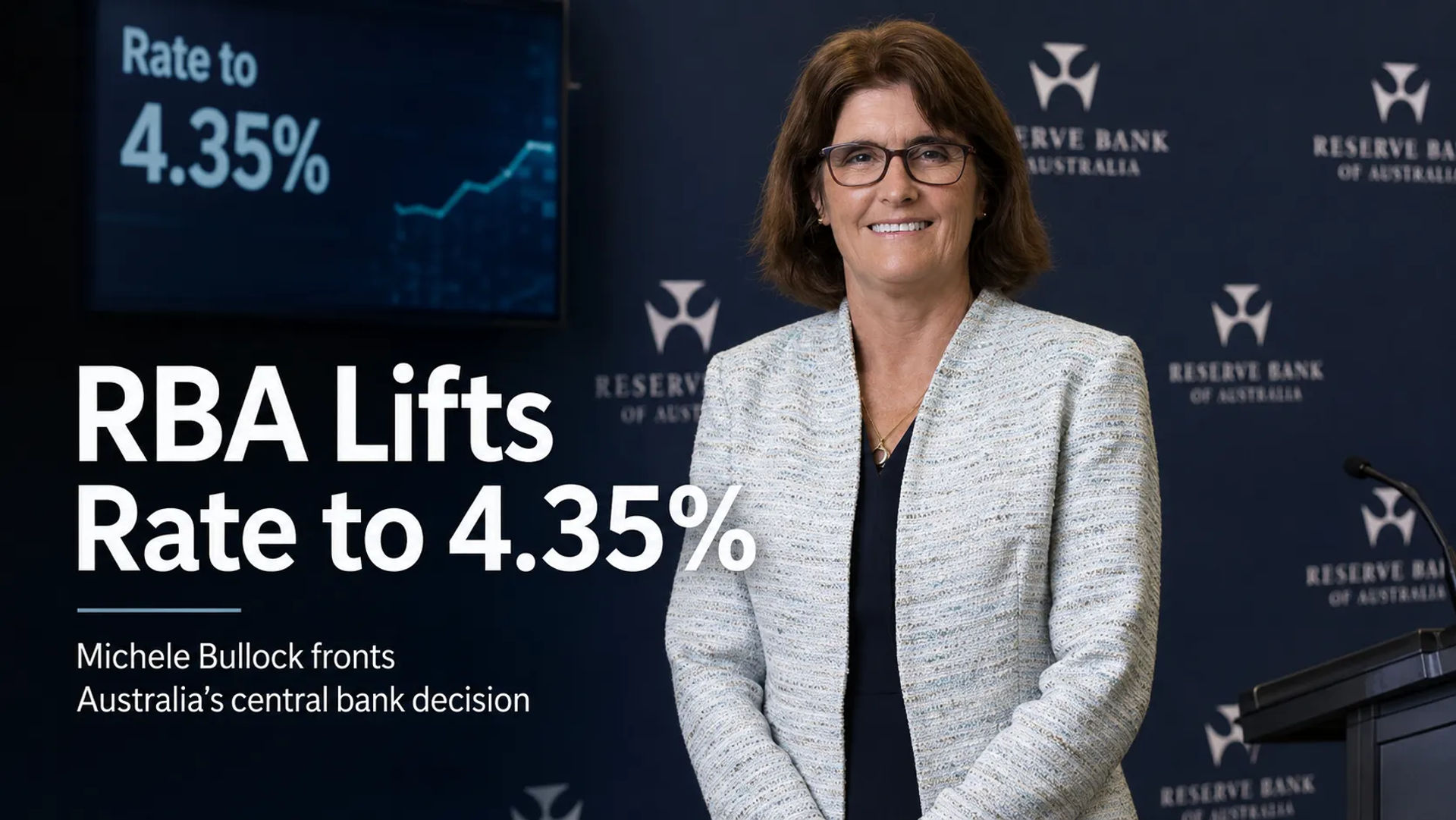
RBA Increases Cash Rate to 4.35 Per Cent as Inflation Hits 4.6 Per Cent
The Reserve Bank of Australia (RBA) has increased the official cash rate by 25 basis points to 4.35 per cent following its board meeting on May 5, 2026. This decision marks the third consecutive rate hike for the year, following previous increases in February 2026 and March 2026. The move was widely anticipated by financial markets as the central bank continues its efforts to curb persistent inflationary pressures within the Australian economy.

The decision to tighten monetary policy comes as Australia's inflation rate reached 4.6 per cent in March 2026. This figure represents the highest level of inflation recorded since 2023. A primary driver of this increase has been the surge in fuel prices, which is directly linked to the ongoing conflict in the Middle East. These external factors have complicated the RBA's mandate to maintain price stability, leading to the 8-1 vote in favour of the 0.25 per cent increase. One member of the Monetary Policy Board dissented from the majority decision, reflecting the complex economic landscape the organisation must navigate.
Major Australian financial institutions moved quickly to respond to the central bank's announcement. Commonwealth Bank of Australia (CBA), National Australia Bank (NAB), Australia and New Zealand Banking Group (ANZ), Westpac, and Macquarie Bank have all confirmed they will pass on the full 0.25 per cent increase to their variable home loan customers. For borrowers with CBA, NAB, ANZ, and Westpac, the higher interest rates will take effect from May 15, 2026. Customers of Macquarie Bank will see their rates change starting May 22, 2026.

The cumulative effect of the three rate rises in 2026 is placing significant pressure on household budgets. For a borrower with a $600,000 mortgage, this latest 25 basis point increase is estimated to add approximately $91 to their monthly repayments. When combined with the hikes from February and March, these homeowners are now paying $272 more per month than they were at the start of the year. In a specific scenario for a larger debt, a loan balance of $736,259 would see monthly repayments reach $2,657, further stretching the financial capacity of many families across the country.

The RBA has expressed concern regarding potential second-round effects on the economy. By raising the cash rate from 4.10 per cent to 4.35 per cent, the board aims to prevent high inflation from becoming embedded in price and wage-setting behaviour. The central bank has left the door open for further tightening if economic conditions do not align with its inflation targets. This stance follows a period of intense scrutiny, including news reports on April 21, 2026, suggesting the RBA was battling for credibility ahead of the inflation test, and subsequent reports on April 29, 2026, indicating that borrowers were already bracing for this potential hike.
Industry analysts from Canstar, Finder, and Mortgage Choice have noted that the rapid succession of rate hikes is testing the resilience of the housing market. While most banks have remained cautious in their outlook, Westpac has provided a more hawkish forecast. Westpac is currently the only major bank predicting further rate rises later this year, with expectations of two additional 0.25 percentage point increases scheduled for June and August 2026. This would contrast with the more stable path some other institutions had hoped for following the May 5 decision.
Related Articles

Comments
0Loading...
No comments yet. Be the first to share your thoughts.