
New Zealand Unemployment Rate Falls to 5.3% in First Quarter
New Zealand’s labour market showed signs of tightening in the first quarter of 2026, with the unemployment rate declining to 5.3%. This figure, released by Statistics New Zealand on Wednesday, May 6, 2026, represents a decrease from the 5.4% recorded in the final quarter of 2025. The 5.4% rate seen in the December quarter had marked a 10-year high for the country, making the latest reduction a significant shift in the domestic economic landscape.
The 5.3% unemployment rate for the March quarter aligned exactly with the forecast set by the Reserve Bank of New Zealand (RBNZ). However, the result was slightly lower than the 5.4% rate anticipated by various economists and market analysts. This divergence suggests a labour market that is holding up more robustly than some private sector observers had expected, even as broader economic conditions remain under scrutiny.

While the headline unemployment rate fell, other metrics within the labour market report indicated a more complex picture of employment growth. Total employment increased by 0.2% in Q1 2026 compared to the previous quarter. This growth was more modest than the 0.3% rise that economists had projected. The slower pace of job creation, combined with a decrease in the participation rate, suggests that the decline in the unemployment rate was not solely driven by a surge in new positions. The participation rate fell to 70.4% in the first quarter, down from 70.5% in the December quarter of 2025.
Wage growth data provided further context for the Reserve Bank of New Zealand as it assesses inflationary pressures. The Labour Cost Index, specifically for the private sector excluding overtime, rose by 0.5% on a quarter-on-quarter basis. This was slightly higher than the 0.4% estimate previously calculated by analysts. On an annualised basis, certain segments of the labour market continue to track near the 2.0% mark, reflecting a environment where wage growth remains subdued despite the lower jobless rate. Market data monitored by Fusion Media Limited and other financial platforms suggests that there remains ample spare capacity in the labour market, which may continue to dampen significant wage-led inflation in the near term.

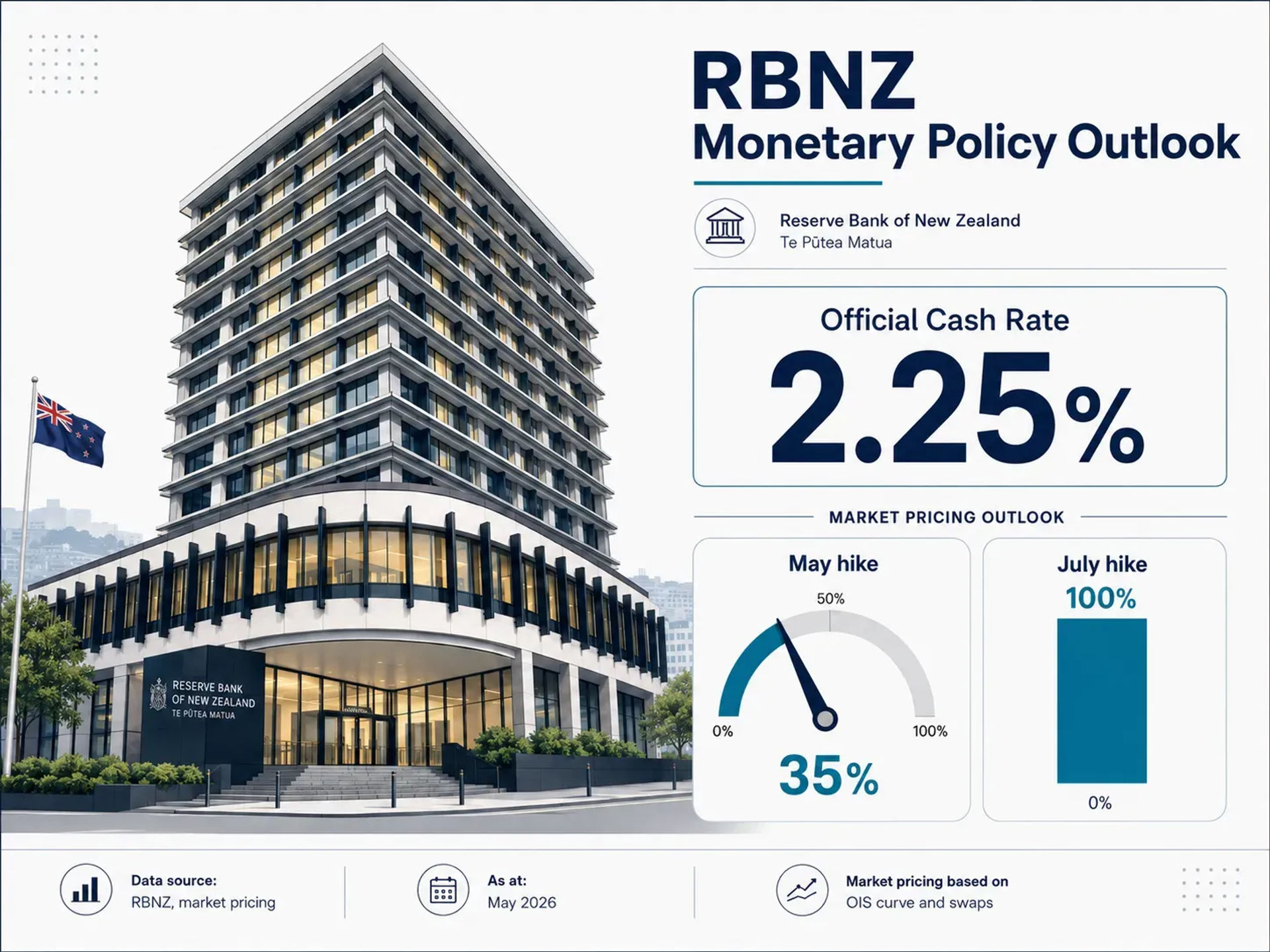
The Reserve Bank of New Zealand has been closely monitoring these labour statistics following its decision in April 2026 to hold the official cash rate at 2.25%. At that time, the central bank indicated it was awaiting further economic data and assessing the potential impacts of geopolitical developments. Following the release of the Q1 2026 data, financial markets have adjusted their expectations for future monetary policy. There is currently a 35% chance of an interest rate hike in May, while a hike is fully priced in for July 2026.
Economists from Westpac, Kiwibank, and ASB Bank have noted that while the current figures show resilience, the long-term outlook is clouded by international factors. Specifically, the full impact of the Middle East conflict on the New Zealand labour market is expected to be delayed. Current projections suggest that the economic consequences of this conflict will not be fully realised for another 6-12 months. This timeframe implies that the labour market may face renewed pressure in late 2026 or early 2027 as global supply chain disruptions and energy price volatility eventually filter through to local hiring decisions.
Related Articles
Comments
0Loading...
No comments yet. Be the first to share your thoughts.
