ASX 200 Plunges on Global Hostilities and Inflation Fears, Wiping $50 Billion
The S&P/ASX 200 Index suffered a significant decline on Friday, May 8, 2026, as geopolitical tensions in the Gulf region triggered a broad-based sell-off across the Australian share market. The benchmark index fell 1.51% to close at 8,744.35 points, resulting in approximately $50 billion being wiped from the value of domestic equities in a single session. This sharp downturn was primarily driven by renewed hostilities between the United States and Iran, which sent Brent Crude Oil prices surging above the $100 a barrel threshold and reignited global concerns regarding persistent inflation.
Every sector on the Australian Securities Exchange (ASX) closed in negative territory, reflecting a widespread risk-off sentiment among investors. The escalation of military exchanges between the United States and Iran near the Strait of Hormuz on Friday morning disrupted the relative stability seen earlier in the week. While the market had finished in positive territory on May 7, 2026, gaining 1% to reach 8,878 points, the sudden shift in the geopolitical landscape reversed those gains and left the index well below its February 2026 all-time high of 9202.90 points.

Geopolitical Conflict and Energy Market Volatility
The primary catalyst for the market retreat was the outbreak of fresh military hostilities in the Middle East. Following a period in April 2026 where peace talks between the United States and Iran had stalled, there were brief hopes in early May for a diplomatic breakthrough that might have reopened the Strait of Hormuz. However, the renewed exchanges on Friday sparked immediate fears of supply chain disruptions in the energy sector.

Brent Crude Oil climbed rapidly to exceed $100 a barrel, a level that historically signals increased input costs for businesses and higher transport expenses for consumers. Despite the rise in the price of the underlying commodity, energy stocks did not provide a hedge for the broader market. Major producers including Woodside Energy and Santos saw their share prices fall by approximately 1.4%. This decline suggests that investors were more concerned with the broader economic implications of regional instability and the potential for a global slowdown than the short-term revenue gains from higher oil prices.
Banking Sector and Financial Impact
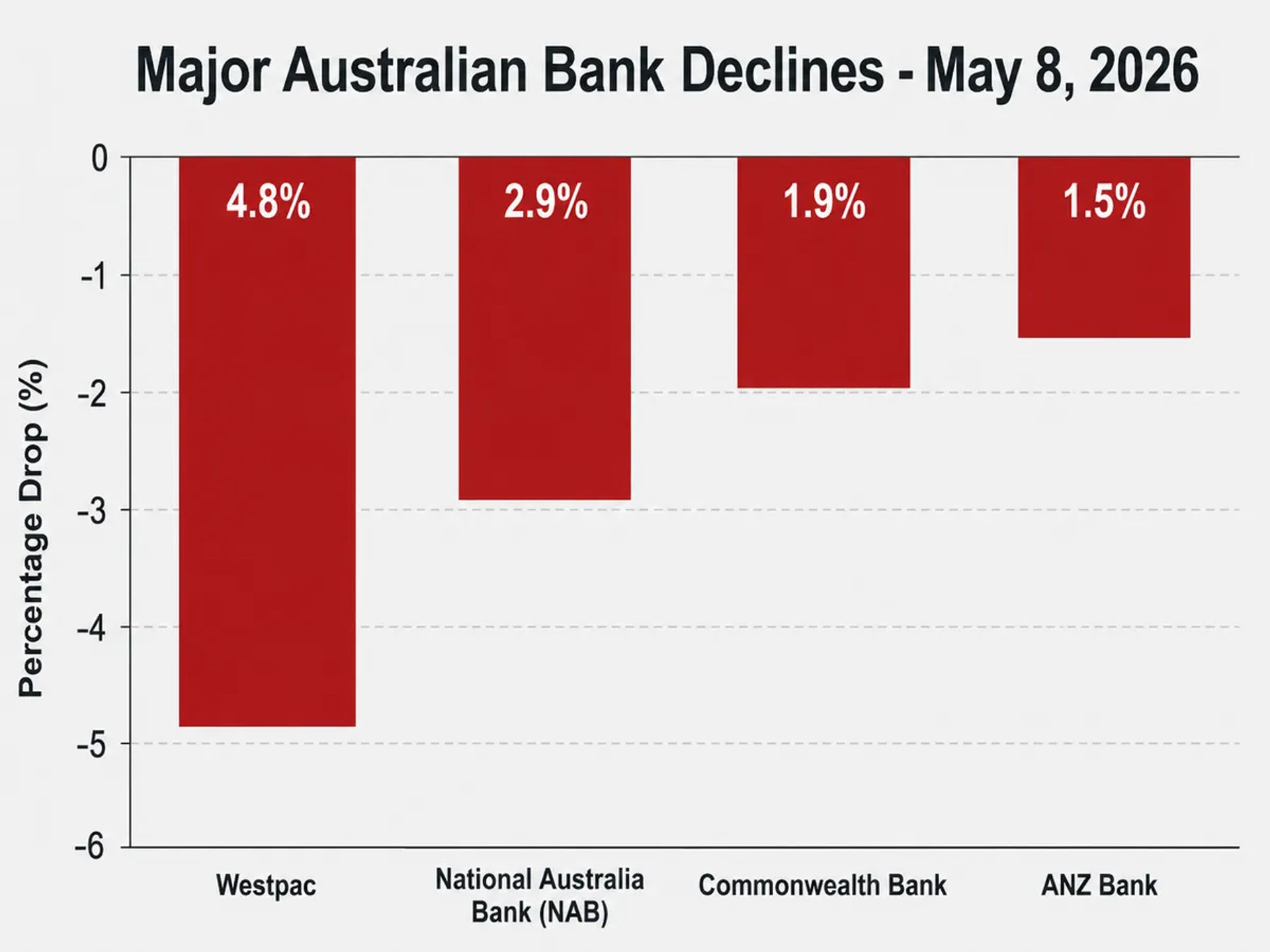
Australia’s major financial institutions bore the brunt of the selling pressure on Friday. The banking sector, which often serves as a proxy for the health of the domestic economy, saw substantial losses across all four major pillars. Westpac recorded the most significant drop, falling 4.8%, followed by National Australia Bank (NAB) which declined by 2.9%. Commonwealth Bank and ANZ Bank also faced selling pressure, dropping 1.9% and 1.5% respectively. Even diversified financial groups like Macquarie Group were caught in the downward trend as the market grappled with the implications of heightened global risk.
Related Articles


Comments
0Loading...
No comments yet. Be the first to share your thoughts.